Internal Quality Assurance Cell - IQAC
Internal Quality Assurance Cell (IQAC)
The Internal Quality Assurance Cell (IQAC) of A.K.T. Memorial College of Engineering and Technology functions under the guidance of the Management and Principal of the Institution to ensure continuous quality improvement in academic and administrative activities.
The IQAC is established in accordance with the guidelines of the National Assessment and Accreditation Council to institutionalize quality assurance strategies and promote a culture of excellence through systematic planning, monitoring, evaluation, and continuous improvement practices.
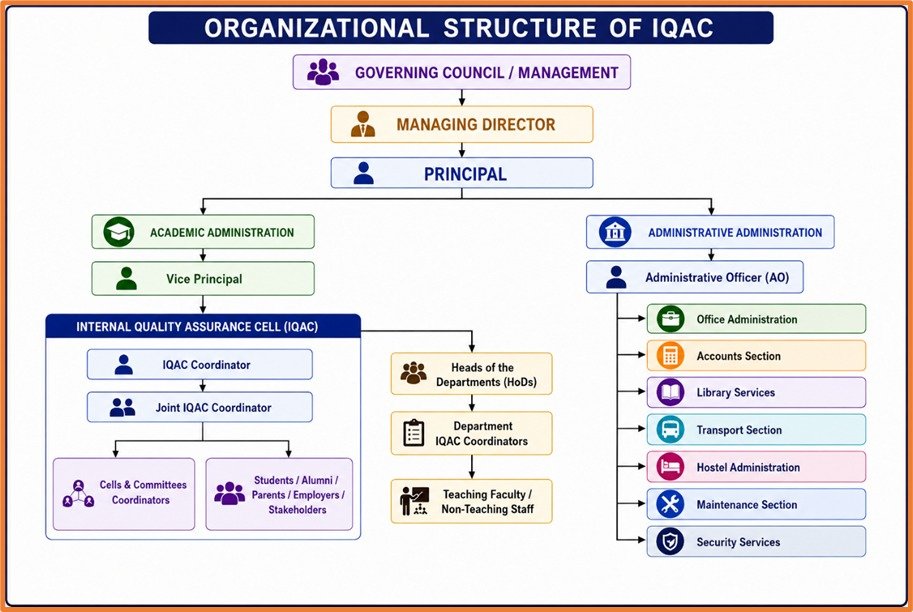
Academic activities are coordinated through the Vice Principal, IQAC, Heads of Departments, Department IQAC Coordinators, and various Cells and Committees Coordinators to ensure continuous quality enhancement in teaching-learning processes, research, innovation, entrepreneurship, and student-related activities.
The IQAC works closely with Cells & Committees Coordinators and engages Students, Alumni, Parents, Employers, and other Stakeholders to promote quality culture, stakeholder participation, and institutional excellence.
Administrative administration is managed through the Administrative Officer (AO), who supervises Office Administration, Accounts Section, Library Services, Transport Section, Hostel Administration, Maintenance Section, and Security Services to ensure effective institutional support services.
The IQAC serves as a central quality assurance mechanism integrating academic and administrative processes for continuous improvement, effective implementation of Outcome Based Education (OBE), accreditation requirements, industry expectations, and alignment with global sustainable development goals.
Vision
To establish a quality-driven academic ecosystem that promotes innovation, entrepreneurship, academic excellence, research culture, and socially responsible engineering education aligned with global standards and sustainable development.
Mission
- To institutionalize quality assurance mechanisms for continuous academic and administrative improvement.
- To support Outcome Based Education (OBE) and accreditation processes including NBA and NAAC.
- To promote innovation, entrepreneurship, research, and industry-integrated learning.
Objectives
The IQAC continuously works towards achieving academic excellence, quality enhancement, innovation, and institutional development.
Quality Benchmarks
Develop and apply quality benchmarks for academic and administrative activities.
Teaching Improvement
Promote continuous improvement in teaching-learning processes.
Accreditation Support
Facilitate accreditation, ranking, and quality certification processes.
Performance Monitoring
Monitor institutional performance through measurable quality indicators.
Innovation & Research
Strengthen research, innovation, entrepreneurship, and industry collaboration.
Outcome Based Education
Ensure effective implementation of Outcome Based Education (OBE).
Feedback System
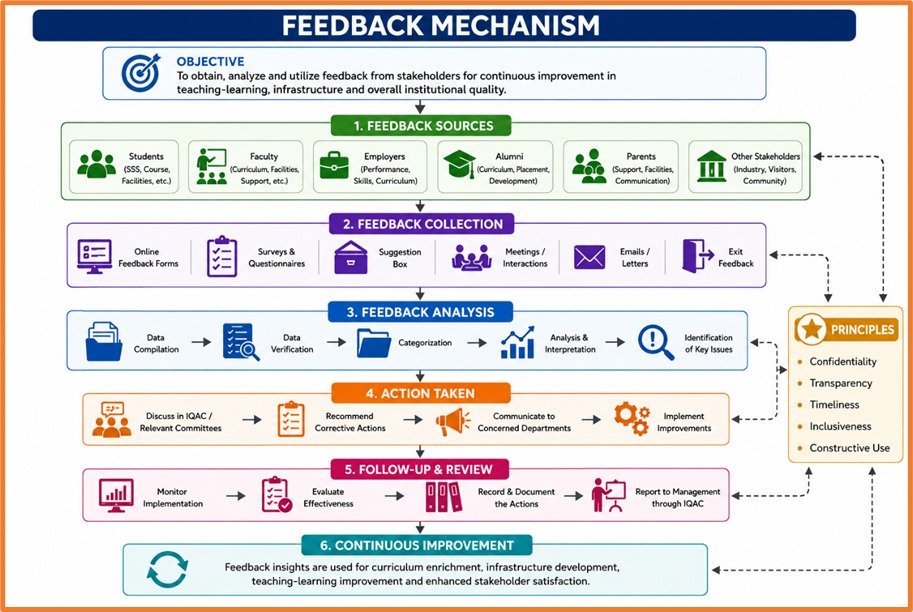
Establish mechanisms for feedback collection, analysis, and corrective action.
Best Practices
Encourage best practices and institutional distinctiveness.
Social Responsibility
Promote environmental consciousness, ethics, inclusiveness, and social responsibility.
Composition of IQAC
The following members are designated as members of the Internal Quality Assurance Cell (IQAC) of A.K.T. Memorial College of Engineering and Technology.
The IQAC is entrusted with the responsibility of establishing benchmarks for both academic and administrative activities in alignment with institutional objectives and statutory quality standards.
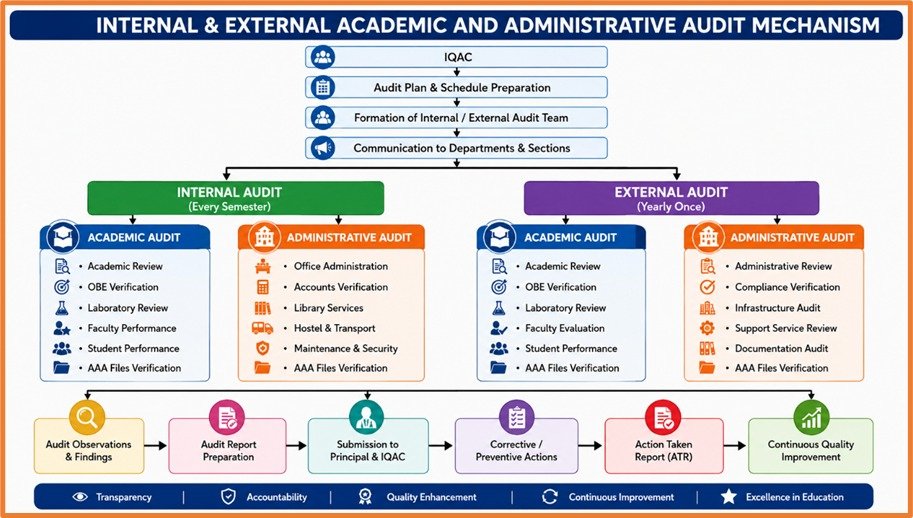
The Cell systematically monitors academic and administrative processes, maintains comprehensive records of quality enhancement initiatives, and conducts periodic internal audits to assess and evaluate the overall performance of the Institution.
Based on its observations and assessments, the IQAC prepares detailed reports highlighting outcomes, best practices, gaps, and areas for improvement.
These reports, along with specific recommendations, are submitted to the Management and the Governing Body of A.K.T. Memorial College of Engineering and Technology to facilitate informed decision-making, policy formulation, and continuous quality improvement across the Institution.
Quality Monitoring
Continuous monitoring of academic and administrative activities.
Documentation
Maintaining records of quality initiatives and best practices.
Internal Audits
Periodic assessment and evaluation of institutional performance.
Policy Support
Recommendations submitted for institutional quality enhancement.
IQAC Members
Internal Quality Assurance Cell (IQAC) Composition of A.K.T. Memorial College of Engineering and Technology
| Sl. No. | Name of the Member | Designation | Composition of IQAC Members Specified by NAAC |
|---|---|---|---|
| MEMBER OF THE MANAGEMENT | |||
| 1 | Thiru. T.M. Rajendran | Managing Director | Member |
| CHAIRPERSON: HEAD OF THE INSTITUTION | |||
| 2 | Dr. T.S. Sivakumaran | Principal | Chairperson |
| TEACHERS TO REPRESENT ALL LEVELS | |||
| 3 | Dr. J. Vengadesh Marshall Raman | HoD – Civil | Member |
| 4 | Dr. S. Jayasundar | HoD – CSE | Member |
| 5 | Mr. S.S. Raju | HoD – ECE | Member |
| 6 | Dr. A. Alaudeen | HoD – EEE | Member |
| 7 | Dr. S. Ramesh | HoD – AI&DS | Member |
| 8 | Dr. V. Ravi Kumar | HoD – IT | Member |
| 9 | Mr. K. Manikandan | HoD – S&H | Member |
| SENIOR ADMINISTRATIVE OFFICER | |||
| 10 | Mr. P. Ramachandran | AO / Office | Member |
| NOMINEES EACH FROM LOCAL SOCIETY, STUDENTS, AND ALUMNI | |||
| 11 | Mr. P. Ramkumar | Lions Club Member | Member |
| 12 | Mr. V. Vignesh Kumar | IV Year – EEE | Member |
| 13 | Ms. R. Kayalvizhi | Alumni | Member |
| 14 | Mr. K. Kalaivanan | AE / TANGEDCO | Member |
| NOMINEE EACH FROM EMPLOYERS / INDUSTRIALISTS / STAKEHOLDERS | |||
| 15 | Mr. M. Ajay Viswanathan | Founder and CEO of Super Fact Solution | Member |
| 16 | Mrs. V. Veeralakshmi | M/O Mr. V. Vignesh Kumar, IV Year – EEE | Member |
| SENIOR TEACHERS AS THE CO-ORDINATOR / DIRECTOR OF THE IQAC | |||
| 17 | Dr. S. Sivakumar | Vice Principal | IQAC – Coordinator |
| 18 | Dr. M.P. Prabakaran | ASP – ECE | Joint – IQAC Coordinator |
Roles & Responsibilities
The Internal Quality Assurance Cell (IQAC) plays a vital role in maintaining and enhancing the quality standards of academic and administrative activities within the Institution.
Establish quality benchmarks and parameters for various academic and administrative activities.
Contribute to the formulation and review of academic and administrative policies.
Maintain records of meetings, decisions, and institutional quality documents.
Facilitate self-assessment and accreditation processes of the institution.
Monitor the implementation of quality enhancement initiatives.
Evaluate the effectiveness of academic and administrative processes.
Develop stakeholder feedback collection and analysis mechanisms.
Conduct periodic quality audits to assess institutional performance.
Identify improvement areas and recommend corrective measures.
Promote faculty development programs to improve teaching and research.
Enhance student support services including counseling and career guidance.
Publish AQAR and other quality documents for stakeholders.
Collaborate with institutional cells and committees for holistic quality assurance.
Submit reports and recommendations to management and governing authorities.
Meeting Procedures
The Internal Quality Assurance Cell (IQAC) follows a structured meeting procedure to ensure effective planning, monitoring, implementation, and continuous quality enhancement within the Institution.
Regular Meetings
IQAC internal meetings shall be conducted every month and external meetings shall be conducted at least twice in every semester.
Agenda Circulation
Meeting agenda shall be circulated to all members prior to the meeting.
Minutes Recording
Minutes of meetings shall be recorded and approved by the Chairperson.
ATR Review
Action Taken Reports (ATR) shall be reviewed in subsequent meetings.
Special Meetings
Special meetings may be conducted based on institutional and accreditation requirements.
Documentation
IQAC Coordinator shall maintain meeting notices, agendas, minutes, attendance records, and ATR documentation.
Annual Action Plan
The Annual Action Plan of IQAC focuses on academic excellence, quality assurance, accreditation readiness, research development, stakeholder engagement, and sustainable institutional growth.
| Sl. No. | Activity | Timeline | Responsibility | Expected Outcome |
|---|---|---|---|---|
| 1 | Academic Audit | Semester-wise | IQAC | Quality enhancement |
| 2 | Feedback Collection & Analysis | Every Semester | IQAC | Curriculum improvement |
| 3 | Faculty Development Program (FDP) | Every Semester | IQAC & HoDs | Skill enhancement |
| 4 | OBE Attainment Analysis | Semester-wise | All Faculty & IQAC | Improved attainment |
| 5 | Research Promotion Activities | Annual | R&D Cell & IQAC | Increased publications |
| 6 | Green Audit | Annual | IQAC | Sustainable campus |
| 7 | NBA/NAAC Documentation Review | Periodic | IQAC | Accreditation readiness |
| 8 | Anna University Affiliation Compliance Submission | Annual | IQAC, AO & Principal Office | Successful affiliation renewal |
| 9 | AICTE Approval Process Monitoring | Annual | IQAC, AO & Principal Office | AICTE approval compliance |
| 10 | AISHE Data Submission | Annual | IQAC, AO & Principal Office | Timely AISHE submission |
| 11 | NIRF Data Collection & Submission | Annual | IQAC, AO & Principal Office | Improved NIRF participation |
| 12 | Student Satisfaction Survey (SSS) | Annual | IQAC | Stakeholder satisfaction analysis |
| 13 | Internal Academic & Administrative Audit | Annual | IQAC | Process improvement |
| 14 | Industry Interaction & MoU Activities | Every Semester | HoDs, T&P Cell & III Cell | Enhanced industry collaboration |
| 15 | Placement and Higher Education Analysis | Annual | T&P Cell & IQAC | Improved employability |
| 16 | Energy / Environment / Green Campus Audit | Annual | IQAC | Sustainable institutional practices |
| 17 | Alumni Interaction & Feedback | Every Semester | Alumni Cell & IQAC | Strengthened alumni engagement |
| 18 | Institutional Website Quality Review | Periodic | IQAC & IT Team | Updated and transparent information |
| 19 | Research Publication & Patent Monitoring | Every Semester | R&D Cell & IQAC | Increased research output |
| 20 | Best Practices & Institutional Distinctiveness Documentation | Annual | IQAC | NAAC/NBA quality enhancement |
Key Performance Indicators (KPIs)
The following Key Performance Indicators (KPIs) are established to monitor institutional performance, academic quality, stakeholder satisfaction, and continuous improvement initiatives.
| KPI | Target |
|---|---|
| 🎓 Pass Percentage | Above 85% |
| 💼 Placement Percentage | Above 95% |
| 📚 Faculty Publications | Minimum 2 per faculty/year |
| 👨🏫 FDP Participation | 100% faculty participation |
| 😊 Student Satisfaction Index | Above 80% |
| 🤝 Industry Interaction Programs | Minimum 5 per year |
| 💡 Patent / Innovation Activities | Continuous increase |
| 📈 OBE Attainment | Above target level |
SDG Mapping
IQAC activities are aligned with the United Nations Sustainable Development Goals (SDGs) to promote quality education, sustainability, innovation, inclusiveness, and institutional social responsibility.
| Sl. No | IQAC Activity | SDG Goal | SDG Theme |
|---|---|---|---|
| 1 | 🎓 Quality Education & OBE | SDG 4 | Quality Education |
| 2 | 💼 Skill Development & Placement | SDG 8 | Decent Work & Economic Growth |
| 3 | 💡 Research, Innovation & Industry Collaboration | SDG 9 | Industry, Innovation & Infrastructure |
| 4 | 👩 Women Empowerment | SDG 5 | Gender Equality |
| 5 | 🌱 Green Campus & Sustainability | SDG 13 | Climate Action |
| 6 | 🤝 Inclusive Practices & Student Support | SDG 10 | Reduced Inequalities |
| 7 | ⚖️ Ethical Governance & Transparency | SDG 16 | Peace, Justice & Strong Institutions |
| 8 | 🏥 Health & Wellness Activities | SDG 3 | Good Health & Well-Being |
| 9 | 🏙️ Community Outreach Activities | SDG 11 | Sustainable Cities & Communities |
| 10 | 🌐 Alumni & Stakeholder Collaboration | SDG 17 | Partnerships for the Goals |
OBE / Accreditation Support
The Internal Quality Assurance Cell (IQAC) actively supports institutional quality enhancement, accreditation preparedness, documentation processes, and continuous quality improvement initiatives aligned with national educational standards.
OBE Implementation
Outcome Based Education (OBE) implementation support.
Attainment Analysis
CO-PO-PSO attainment analysis and monitoring.
Affiliation Support
Anna University affiliation process support.
AICTE Approval
AICTE approval process monitoring and compliance support.
AISHE Submission
AISHE data collection and submission support.
NIRF Support
NIRF data collection and ranking framework support.
NAAC SSR
NAAC SSR preparation and documentation support.
AQAR & NBA SAR
AQAR preparation and NBA SAR documentation support.
Data Validation
Data validation, verification, and evidence maintenance.
Continuous Improvement
Continuous Quality Improvement (CQI) activities.
Academic Monitoring
Academic performance monitoring and quality analysis.
Stakeholder Analysis
Stakeholder satisfaction analysis and feedback monitoring.